Invitation
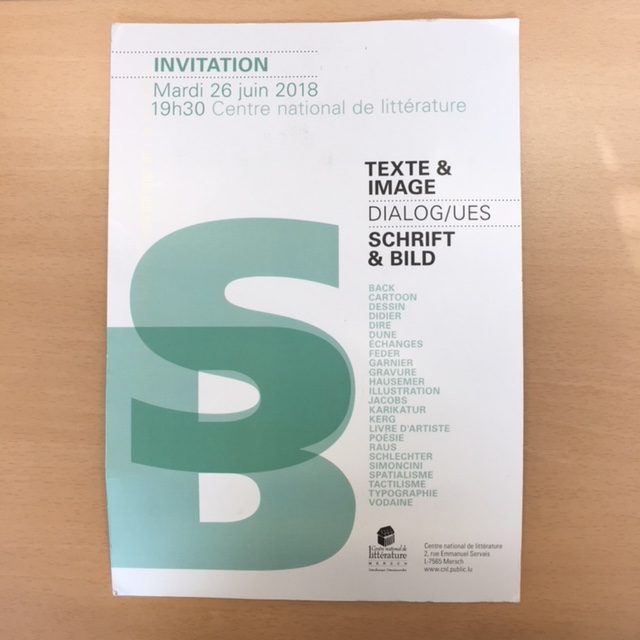
I am attaching an invitation to an exhibition where one of the five halls at the National Center for Literature (CNL) in Mersch will be dedicated to our compatriot Jean Vodain from June 26th. See: https://cnl.public.lu/en/agend
I also ask you to publish the invitation on the social website.
I'm sending you some more pictures from the CNL website, which you can find at: https://cnl.public.lu/fr/agend
Here is an article by Marjan Drnovšek from the magazine Dve domovini/Two Homelands, ZRC SAZU, dedicated to Lorena, from 2002. And what does >bad adn< mean in the title of this article? It means >Be someone!< in the Tolmin dialect. These are the words of his mother. He also transferred this to his French surname Vodaine (by replacing the letter >b< with >v<).
As far as I know, no Slovenian artist who has been creatively present (also) in Luxembourg has been given such a great honor here.
We will hear more about him, as a special volume of the collected works of the great Luxembourg poet Edmond Dun (correspondence), with whom J. Vodaine was friends and corresponded, is being prepared.
Thanks in advance!
Kind regards, Vera Pejovič
About the exhibition
Bad adn: Jean Vodaine
Two Homelands Magazine
Lorraine, 2002
http://www.sistory.si/cdn/publikacije/15001-16000/15059/Dve_domovini_16.pdf
Tolmin Museum; Pilon Gallery in Ajdovščina (ed. Irene Mislej), 2002, 75 pp.
Who is Jean Vodaine? Better known to artistic and emigrant circles than to the wider Slovenian public and
even as a Knight of Arts and Letters, more in French circles than in his native Slovenia. He is a poet
and translator and publisher, printer and illustrator, and often all these activities are combined in his work
They intertwine with each other. But he is not completely unknown, as he was written about in the Primorska dnevnik
(1964), Marijan Tršar in Our Views (1968), Božidar Borko in Le livre slovenè, Tit Dobršek in
Delu (1969) and others; it was given its place in the Encyclopedia of Slovenia (2000) and even before that in
Primorsko Slovensko Biografski Lexikon (1982), similar to his "French" compatriot,
composer and trombonist Vinko Globokar, who is better known in the media. Only in the last decade
we are increasingly "discovering" Slovenian intellectuals around the world, especially those who were more or less
"uninteresting" for the Slovenian (political) public or contacts were limited to a personal level. But it is not
ideological intolerance was always to blame, but often just negligence, lack of interest,
complacency or pushing to the edge of our behavior in spirit, as it concerns people who live abroad and
most of them don't even know Slovenian. I think that these kinds of views are collapsing, although with some
Too little enthusiasm. Sorry.
An illustratively rich publication was published to accompany the exhibition by Vladimir Kaučič (Jean Vodain) –
it was designed by Ranko Novak - who, in addition to French and Slovenian written reflections, provides us with a comprehensive
introduces Vladimir (Frédéric) Kaučič; he moved to France with his parents as a three-year-old child, where
still lives today. The words of welcome were spoken to him by Silvester Gaberšček (Welcome instead of
introduction/La bienvenue au lie de la préface), mag. writes about his pictorial and poetic works.
Petra Černa Oven (Spelling as a tool of poetry/La typographie, instrument de poésie), about
friendship between Pilon and Vodaine by Dr. Irene Mislej (Pilon and Vodaine, creative
friendship/Pilon et Vodaine, une amitie créatrice) and about Vodaine's return Joe Ryezko (Vodaine
back home/Vodaine est de retour), after which Vodaine himself gets the floor (Here and there. Excerpts from
The Traveler's Solstice/A batons rompus. Extracts from the Passagers du Solstice). In the end, you can
Let's walk through his life so far (Biography), and also learn about
a review of his works located in Slovenia (Bibliography of works in Slovenia/Bibliographie des
œuvres en Slovénie) and are kept by the Pilon Gallery in Ajdovščina, the Tolmin Museum in Tolmin and
National and University Library in Ljubljana. These are works that he created as an author and
translator, publisher, printer and illustrator. Finally, a selection of bibliography on Vodain is added.
I leave Vodain's artistic and literary creativity to the experts to evaluate, I will only mention
The motto chosen by Petra Černe Oven as the introduction to her contribution, which eloquently expresses his work:
"Das Word und das Bild sind eins. Maler und Dichter gehören zusammen!” (Hugo Ball, Flucht
aus der Zeit, 13. 6. 1916). In the following, I would like to list just a few thoughts about his life path.
or rather, memories of his father's beginnings in France. According to him, his parents emigrated from
of the then Venetian Republic of Tolmin for economic and political reasons, as their fathers
forced him to join the Fascist Party so he could keep his workshop. This was in 1924. As
Like many other Slovenians, he decided to travel abroad, coming to the Moselle department, where he initially worked in
in the Algrange mines, after which he went "on his own" and worked as a shoemaker. Vodaine also left after completing his studies.
He trained as a shoemaker at a Catholic folk school. In Basse-Yutz, where they rented a house, they met with the people
communicated in German (after all, the parents went to a public school in Austria), the mother knew
also Italian, but at home they spoke Slovenian. However, since Poles probably represented the majority
immigrants there, the Kaučičs also became "Poles", which was the designation for all foreigners who
soon acquired a pejorative meaning. As a child, he was linguistically shaped by a children's society, where
acquired knowledge of "Alsatian" or a mixture of the kind spoken in Lorraine, and only with the entry
In elementary school he encountered French, which, if I understand his memories correctly, attracted him to
not then, but later. He mostly learned it himself. Knowing the language of the environment in which you live is
important for anyone who wants to work creatively in it. He wrote: “I never felt like I was in France
felt like a foreigner. And for good reason: I had entered the world of the French language” (p. 48).
Mastering French was for the young Kaučič a ticket to his future work, which
faced harsh realities many times. He worked as an unskilled laborer in an ironworks in
Thionville (1951-53), on the railway (1956), was injured at work (1960), later lectured at
School of Fine and Applied Arts in Metz (1972-75). There were quite a few Slovenian artists in
abroad, who had to balance their work for a living with their artistic desires, often also on
damage to artistic activities and plans. Let us also highlight the friendship between Pilon and Vodain.
They were connected by poetry and its depiction, and undoubtedly also by the proximity of their birthplaces, where they feel
the warm influence of the Mediterranean world, and most of all, of course, artistic interests. And what does "bad adn" mean in
the title of the publication? This means “Be someone!” in the Tolmin dialect. These are the words of his
He also carried this over into his French surname Vodaine (by changing the letter "b" to "v").
In short, there is no doubt that Vladimir Kaučič succeeded, despite numerous problems and misunderstandings, which
This is also proven by the presented publication.
Marjan Drnovsek